I’ve always enjoyed building things, whether it’s creating adventures for Merciless Merchants or tackling projects around my property. One of my bigger undertakings has been constructing an outdoor kitchen, complete with a stone fireplace, wood-fired pizza oven, and a rather imposing dragon watching over it all. Special thanks to Jack and Jonbar for helping with the pizza oven and setting it into place.
And what outdoor kitchen would be complete without a dragon?
A Dragon in the Backyard
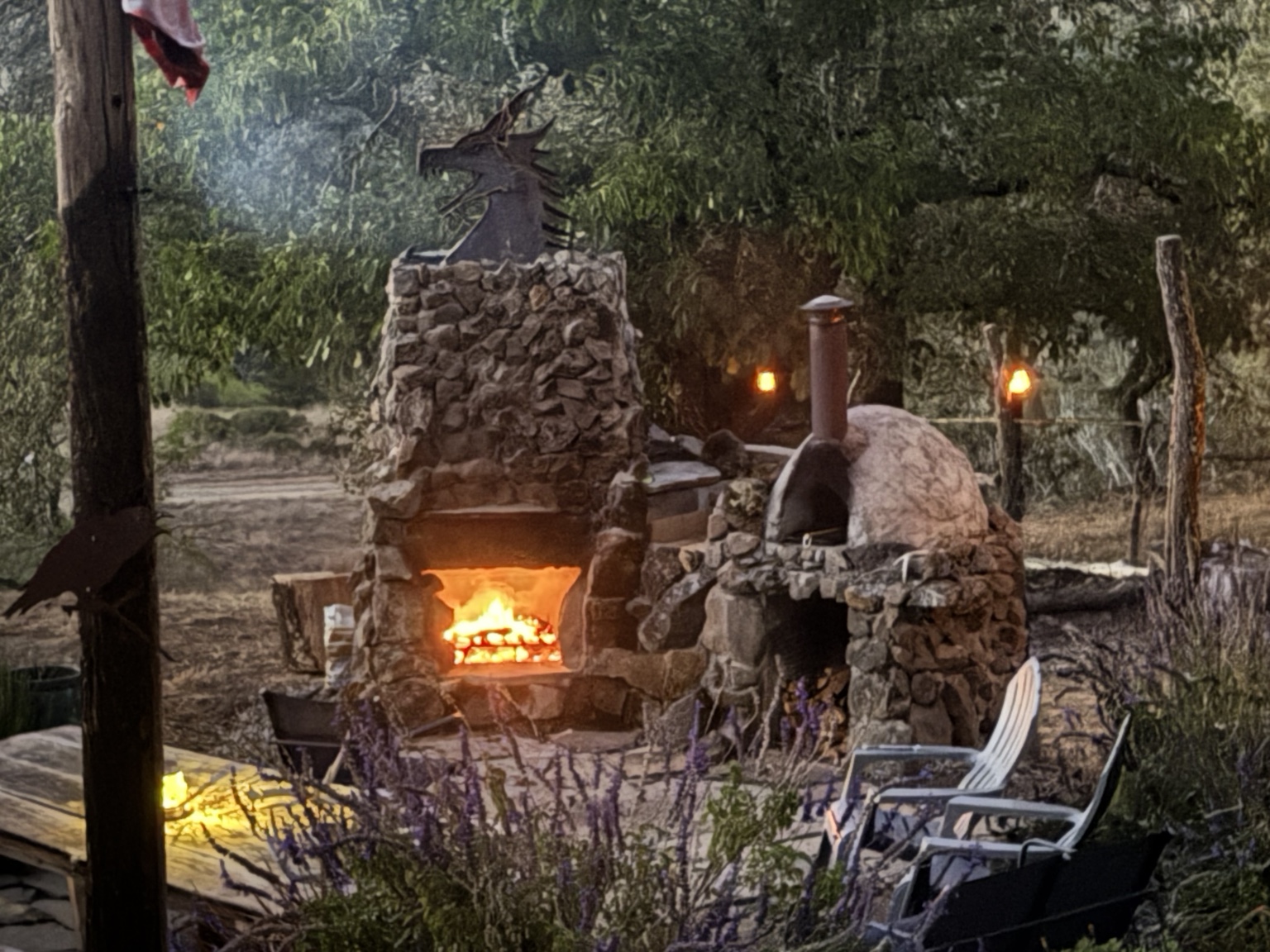
Over time, I’ve been putting together an outdoor cooking area using stone, wood, and plenty of sweat. After the flagstone patio, the centerpiece is a large stone fireplace, with a wood-fired pizza oven beside it. It’s become a great place to spend an evening, particularly when the weather cools down and there’s a fire roaring–especially when Winter is Coming.
But I didn’t want some ordinary chimney cap from Home Depot. I wanted something a little more rustic, something that fit the rest of my yard, where axe throwing, archery, and chopping wood with swords aren’t exactly unusual activities.
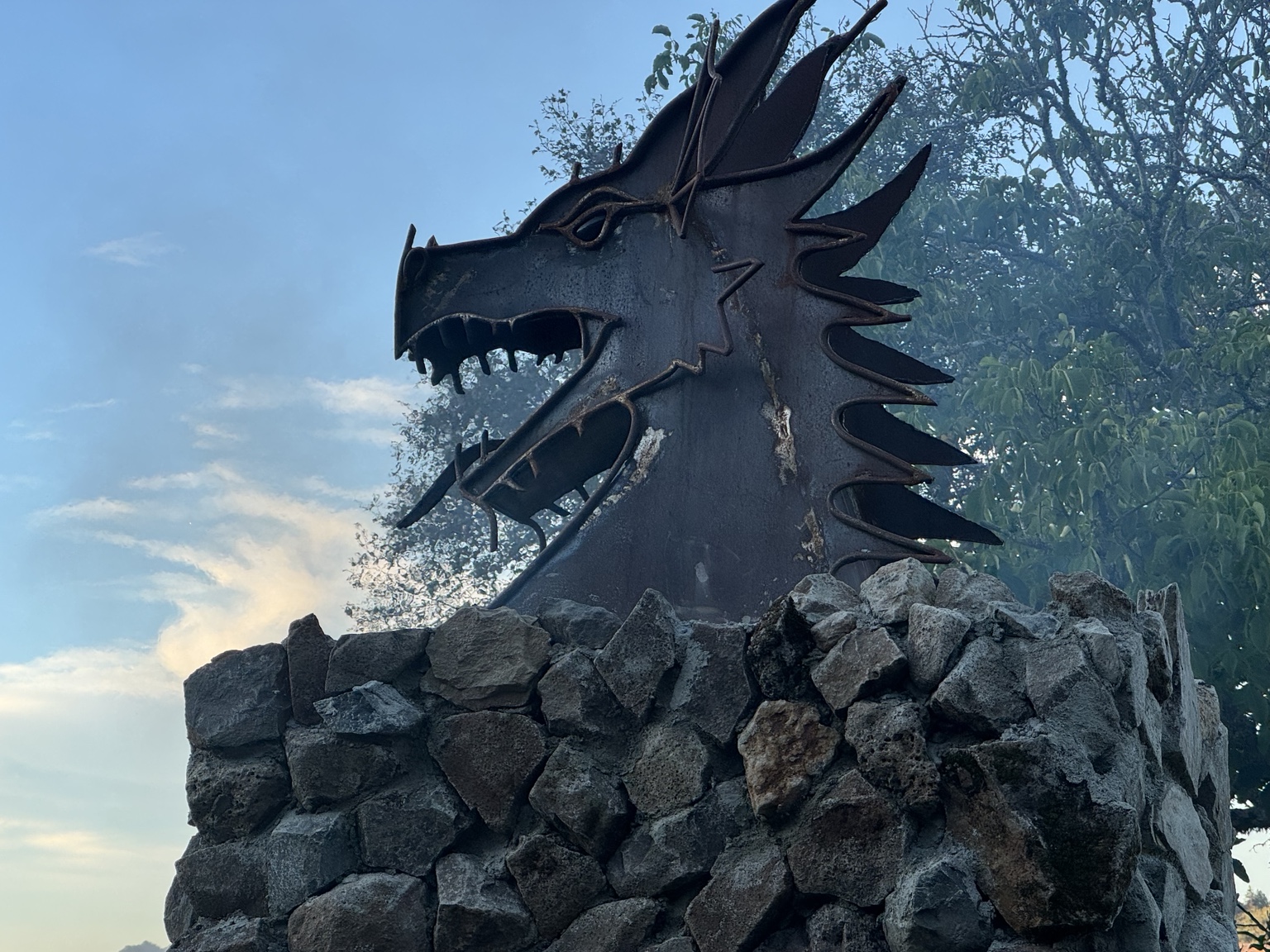
And then it hit me. Why not a dragon’s head that breathes smoke whenever the fireplace is lit?
A dragon’s head, complete with horns, jagged spines, and a mouth full of wicked teeth, seemed like just the thing. Something that looked as though it belonged guarding a treasure hoard deep within the Dragonback Mountains.
Dragon head chimney, created by Tanya Marsh
Of course, I had absolutely no idea how to make one.
That’s where Tanya Marsh of Where the Metals Meet came in.
I stumbled across her company and approached her with the rather unusual request of building a dragon’s head for a chimney. To my surprise, she was excited about the idea! She began sending rough sketches and sharing updates as the dragon slowly took shape.
The finished piece exceeded my expectations. I couldn’t be happier with how it turned out, and I’d highly recommend Tanya to anyone looking for custom metal art or welding work.
There’s something particularly satisfying about sitting beside a roaring fire, looking up at a dragon breathing smoke, and contemplating the next dungeon full of terrible things to inflict upon unsuspecting adventurers.
Speaking of terrible things to inflict upon adventurers…
From Fire to Ice: The Coming of Winter
While the dragon keeps things warm around the homestead, we’ve been preparing to unleash considerably colder misery upon the gaming table.
We’re getting ready to release the adventures from The Coming of Winter as four individual PDFs on DriveThruRPG.
Originally published as a larger collection, The Coming of Wintercontains adventures and supplemental material for AD&D 2nd Edition and For Gold & Glory and came to life thanks to backers of our 2023 Kickstarter. We’ve decided to make the individual adventures available separately for those who might prefer to pick and choose their wintertime misery.
The four releases are:
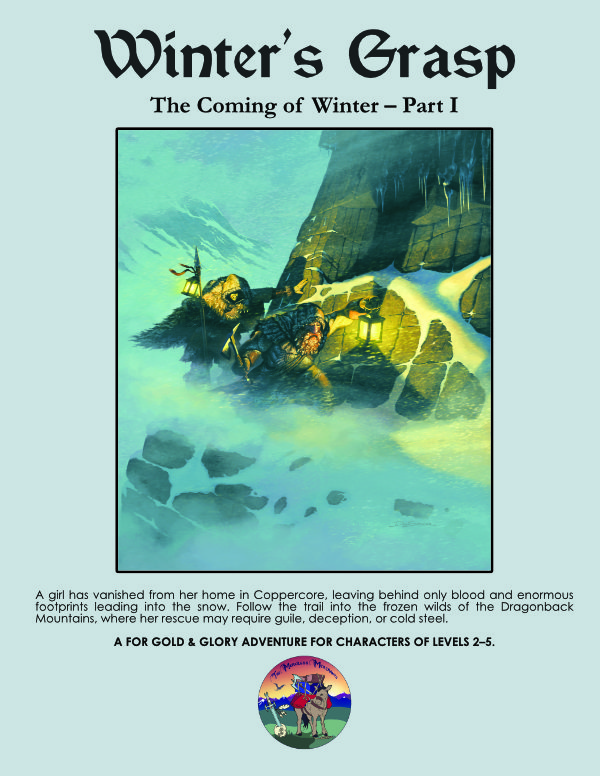
Winter’s Grasp: A frost giant has abducted a young woman, and the adventurers must venture into the frozen wilderness to rescue her.
Winter’s Blight: Ice trolls, an ancient burial mound, and the mysterious Staff of Tiger Claw await those willing to brave the cold.
Ice Needles of the Cryoptera: Strange insectoid creatures, a frozen waterfall, and an ancient evil imprisoned beneath the ice.
Tales of Winter: A collection of winter wilderness encounters, mini-adventures, monsters, spells, and survival material.
We’ll be releasing these individually over the coming weeks.
IMPORTANT: If you’ve already purchased The Coming of Winter, don’t buy these adventures again! You already own the material. As a thank-you to our previous customers and Kickstarter backers, we’re providing complimentary copies of all four individual PDFs through DriveThruRPG.
We’ll be emailing download links to previous purchasers through DriveThruRPG. However, if you’ve opted out of their emails or don’t receive our message, please contact us at themercilessmerchants@gmail.com with your original purchase information, and we’ll make sure you receive your copies.
The complete collection will remain available for those who want everything in one volume.
And the cold isn’t going away anytime soon. We’re also developing Tales of Winter, Part 2, featuring additional new winter adventures and encounters.
But winter isn’t the only danger on the horizon.
Death Maze of the Sorcerer-Kings — Upcoming Kickstarter
I’ve also been busy helping bring Death Maze of the Sorcerer-Kings, an upcoming Kickstarter project, across the finish line.
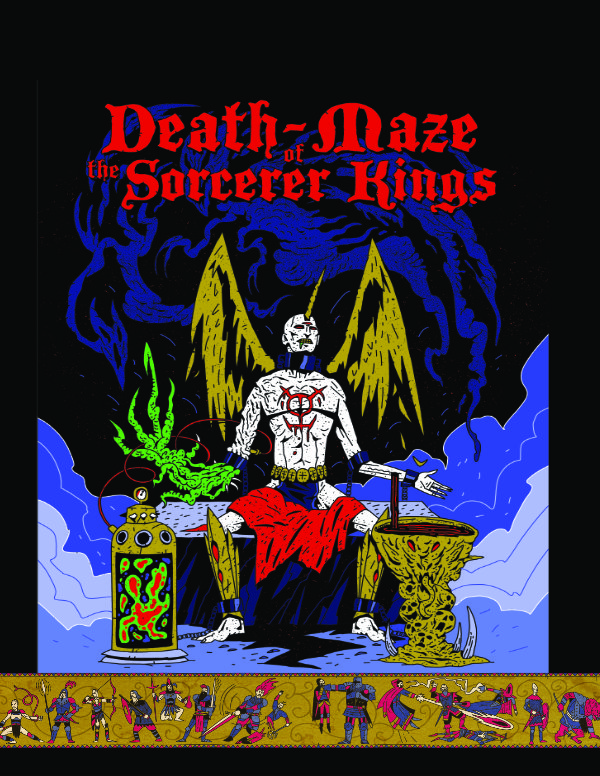
Sneak peak of cover! Artist: Lukasz Piwinski
Written by Ray Weidner, author of Peril in Olden Wood, this is a high-level, old-school city adventure filled with contests, schemers, intrigue, and all manner of crazy situations for the characters to get themselves into.
I’ve been helping Ray with editing and layout, which means plenty of time spent tracking down missing page references, checking details, and making sure everything fits together properly. Not exactly the glamorous side of publishing, but it’s part of turning a manuscript into something ready for the gaming table.
And believe me, there have been a lot of page references.
We’re getting closer to the finish line, and I’ll share more details about the Kickstarter as things develop.
What’s Next for Merciless Merchants?
Beyond these releases, Jonbar and I have been slowly working through a considerable collection of adventures, locations, and ideas we’ve developed over the years. Much of this material centers around Coppercore, a rugged frontier settlement nestled in the Dragonback Mountains, and the surrounding wilderness.
There’s a lot of material to sort through, expand upon, and shape into something suitable for publication. It’s a rather ambitious undertaking, but we’re taking it one piece at a time. Like building an outdoor kitchen, some projects require a little patience, plenty of work, and occasionally a few adjustments along the way.
We’ve got plenty more adventures waiting in the wings. We just need to finish building them.
I recently came across an interesting blog post titled Do Not Overthink the City. The author argues that designing a city adventure isn’t all that different from designing a dungeon. Essentially, you create interesting rooms, populate them with NPCs and things to do, and connect those rooms through directions and information. Think of a city as a dungeon chopped up and scattered across several square miles. It’s an interesting approach, and I agree with some of it. But…
My first thought was: Well, that sounds like a pretty boring city.
My second thought was: Where the hell are all the rumors?
Not every building in a city needs to be mapped and keyed. Not every merchant needs a detailed background, and not every street needs an elaborate description. I also like the author’s suggestion of having NPCs unexpectedly show up at locations, creating complications or introducing new situations. That’s good stuff!
But the more I read, the more I found myself disagreeing with the underlying philosophy.
A city isn’t a dungeon. And I don’t think we should design it like one.
Think about how players explore a traditional dungeon.
They enter a room. There might be three exits. They choose one and continue exploring. The physical layout of the dungeon naturally limits their choices. Walls, corridors, doors, and obstacles determine where the characters can go.
Now consider a city.
There are no dungeon walls restricting the characters’ movement. They can visit the tavern, investigate the docks, speak with the town guard, wander through the marketplace, or knock on some random person’s door. The possibilities are practically endless. So how do we provide structure without restricting that freedom?
Rumors, adventure hooks, and ongoing situations become the walls and corridors of an urban sandbox.
Instead of following physical passages, the players follow information. Maybe they hear that several miners have disappeared. Perhaps two rival guilds are fighting for control of trade. A noble has been murdered, a strange cult is recruiting followers, or a merchant caravan has arrived with disturbing news from a neighboring settlement. Each rumor presents an opportunity. Each situation suggests places to investigate, NPCs to question, and decisions to make.
The players might pursue the missing miners, which leads them to a tavern, then to a mine foreman, and eventually into some forgotten tunnels beneath the city.
Or maybe they couldn’t care less about the miners and decide to investigate the murder instead. That’s the beauty of it! The GM hasn’t forced the players down a particular corridor. The players have chosen their own direction based on what interests them.
In a dungeon, walls determine where you can go. In a city, rumors and situations give you reasons to go somewhere.
A City Should Have a Shitload Going On!
One thing that particularly bothered me about the original article was the suggestion that traveling between locations in a city should generally be skipped because nothing interesting happens.
The author writes:
“Walking from A to B in a city is usually just that, walking.”
Well, sure. If I’m walking to the grocery store, I probably don’t expect anything particularly exciting to happen. But we’re playing Dungeons & Dragons!
I want my fantasy city to feel alive. I want merchants shouting their wares, thieves picking pockets, guards chasing criminals, religious zealots preaching in the streets, drunken mercenaries causing trouble, and desperate townsfolk looking for help. I want the players to feel like they’ve stepped into a place where hundreds of things are happening, whether they’re involved or not.
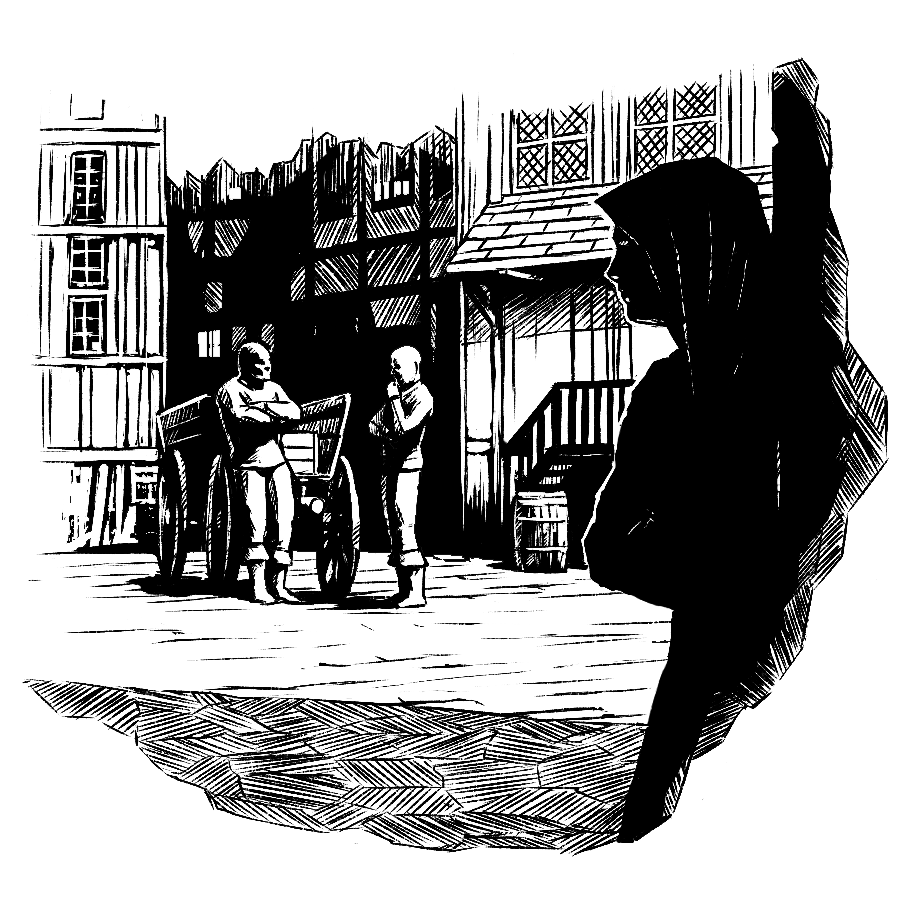
The Forge, Maciej Zagorski
And this is where I think wandering encounters are incredibly valuable. As most of you know, wandering encounters don’t have to mean combat. In fact, some of the best urban encounters might not involve combat at all.
Imagine the characters are heading to the docks to investigate a smuggling operation. Along the way, they encounter a crowd gathering around a public execution. The condemned man suddenly recognizes one of the characters and starts shouting that he’s innocent. What do the players do? Do they stop and investigate? Do they intervene? Do they ignore him and continue toward the docks?
Or perhaps they witness two rival guild members arguing in the street. A merchant approaches them with a suspiciously lucrative offer. A frightened child claims something has been following her home at night. These encounters might lead to entirely new adventures, reinforce existing rumors, or simply provide a glimpse into everyday life.
And just because the players encounter something interesting doesn’t mean they’ll abandon what they’re doing. They might already be determined to investigate those missing miners. The city can have a hundred things happening, but the players decide what deserves their attention.
In a way, that reinforces the idea of rumors and situations acting as the city’s walls. The players have chosen a direction, even though nothing physically prevents them from going elsewhere.
Of course, I’m not suggesting that the GM roll on a wandering encounter table every time the characters cross a street. That would get ridiculous pretty quickly. But dismissing travel as something generally uninteresting seems like a missed opportunity.
Too Many Choices? Good!
One concern with this approach is that players might become overwhelmed by too many rumors, hooks, and situations. I don’t necessarily see that as a problem.
In fact, I think having more opportunities than the characters can reasonably pursue is one of the defining characteristics of a good sandbox.
Imagine the players arrive in a city and discover that:
Two guilds are on the verge of open conflict.
A local noble has been murdered.
A strange creature has been spotted near the cemetery.
A merchant is offering good money to recover stolen goods.
A neighboring settlement has stopped sending supplies.
The players can’t investigate everything. So they talk among themselves, weigh their options, and decide what interests them most.
Perhaps they investigate the strange creature near the cemetary. Great!
Meanwhile, the other situations still exist. The guild rivalry might escalate. The murderer might strike again. The merchant might hire someone else. The city doesn’t revolve around the characters, even though their actions can certainly influence what happens.
Now, I’m not suggesting that the GM needs to create an elaborate timeline for every rumor or track dozens of moving parts. That sounds exhausting and impossible! A few notes about what might happen if the characters ignore a situation are usually sufficient. I also like to organize rumors that lead to actual adventures or dungeons in an appendix, where the GM can easily find the relevant material. A simple reference like “See Appendix A”.
This way, the GM can throw plenty of rumors and adventure hooks at the players without having to dig through the entire book when they decide to pursue one. The players get the freedom to investigate whatever interests them, and the GM has the information readily available.
Give the players plenty of things to investigate and let them figure out what the hell they want to do. The city should offer more adventure than the players have time to experience.
Interesting Rooms or Interesting Situations?
Another point where I disagree with the article is its emphasis on creating interesting rooms. Don’t get me wrong. I love a well-designed location! But I think an interesting situation is often far more valuable than an interesting room. Consider two taverns:
The first has twelve carefully keyed rooms, an eccentric bartender, a secret basement, unusual decorations, and a hidden treasure. Sounds interesting enough.
The second is a fairly ordinary tavern where miners gather after work. Lately, the mine owner has stopped paying wages. Some miners are threatening to strike. Others are afraid they’ll lose their jobs. A guild representative is quietly recruiting troublemakers, and one drunken miner claims the real reason the mine has closed is that something terrible has been discovered underground.
Which tavern would you rather put in front of your players?
For me, it’s the second one.
Not because the first tavern is necessarily bad, but because the second presents a situation the players can actually engage with.They can investigate, negotiate, take sides, ignore the problem, or make things considerably worse. And depending on what they do, that ordinary tavern might become one of the most memorable locations in the campaign.
In a dungeon, an interesting room can create awe and wonder. But in a city, I think the situation is often what makes a location interesting. Most of us can already imagine what a tavern, blacksmith’s shop, or general store looks like. It’s what’s happening inside that makes us want to investigate.
Now, I’m sure the author intends for his rooms to contain interesting NPCs, conflicts, and opportunities. But I think he’s approaching the problem backward. Rather than creating interesting rooms and connecting them, I’d rather create interesting situations and let those situations lead the players to whatever locations become important.
Ideally, of course, we want both interesting locations and interesting situations. But if I have to choose between spending two hours detailing the architecture of a building or spending that time developing interesting rumors, NPC motivations, and potential conflicts, I’ll choose the latter almost every time.
Let the Players Decide What Matters
I think this is the fundamental difference between the approach described in the original article and how I envision an urban sandbox.
The author focuses on creating interesting locations and connecting them into adventures. That’s a perfectly workable approach, particularly if you’re designing a specific city-based adventure. But when I’m designing a settlement intended to support an ongoing sandbox campaign, I want something different.
I want rumors circulating through taverns. Hell, I want different rumors in each tavern depending on where that tavern is located in the city and who usually frequents it. I want factions pursuing their own agendas. I want wandering encounters that introduce unexpected complications. I want NPCs with problems, ambitions, secrets, and opportunities. Most importantly, I want the players to decide which of those things matter.
Perhaps the GM thought the mysterious disappearances would become the central adventure, but the players become fascinated with a minor dispute between two merchants. Wonderful! Run with it.
Maybe that dispute eventually leads to something much larger. Maybe it doesn’t. Either way, the players are making decisions and shaping their own experience.And isn’t that what sandbox play is supposed to be about?
Bringing It All Together
We’re currently working on a frontier settlement called Coppercore for Merciless Merchants, and these are some of the principles I’ve been thinking about as we develop it.
Coppercore has competing guilds, local traditions, political tensions, threats from the surrounding wilderness, and plenty of opportunities for adventure. But I don’t want it to be interesting simply because we’ve written descriptions of dozens of buildings. I want it to be interesting because the characters arrive and discover a settlement bursting with rumors, conflicts, mysteries, and opportunities.
Some of those rumors will lead to fully developed adventures. Others might lead to smaller encounters or unexpected situations. Some might turn out to be false. And some might never be investigated at all. That’s fine! The goal isn’t to ensure that the players experience every adventure we’ve written. Give them a city full of things to do, plenty of rumors to chase, and let them decide where the adventure takes them.
So, while I agree that we shouldn’t overthink every building, room, or street in a city, I think we absolutely should spend time developing the rumors, situations, encounters, and relationships that make the place feel alive. Because ultimately, I don’t want my players to feel like they’re exploring a dungeon with the walls removed.
I want them to feel like they’re exploring a city.